Pentax Made a New Film Camera in 2024
The Pentax 17 half-frame camera — Ricoh Imaging's decision to manufacture a new film body in 2024, its stated design rationale, and its position in the half-frame revival alongside the Kodak Ektar H35.
A half-frame body from a manufacturer that still knows how
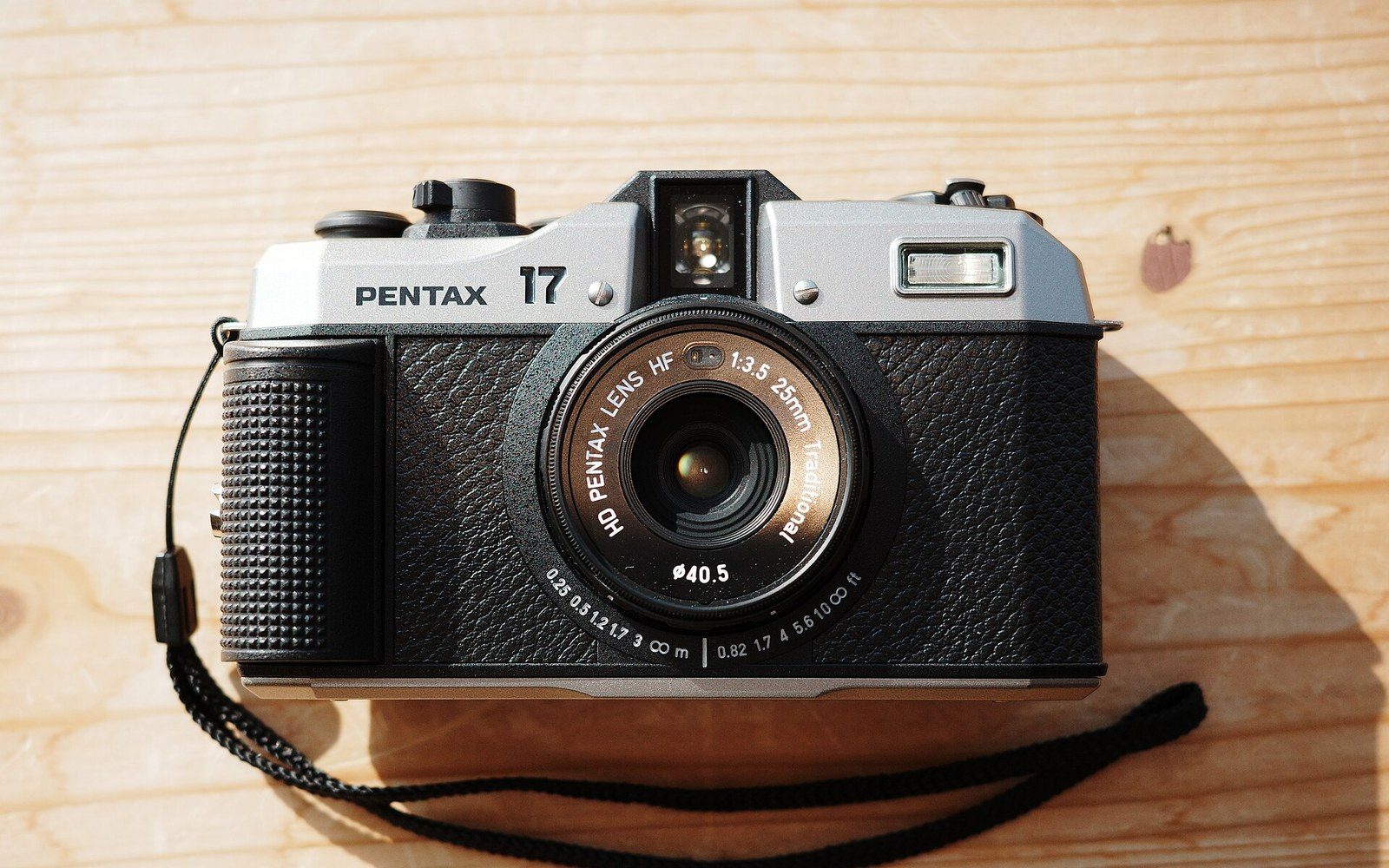
Ricoh Imaging — which has held the Pentax brand since acquiring it from Hoya Corporation in 2011 — announced the Pentax 17 in June 2024, making it one of the very few mass-produced film cameras designed and built new in the twenty-first century. The body is a half-frame 35mm camera: each exposure occupies half a standard 35mm frame, oriented vertically, which means a 36-exposure roll yields up to 72 shots. The format dates to cameras like the Olympus Pen series of the early 1960s, but the Pentax 17 is not a reissue — it is a ground-up design with a 25mm f/3.5 lens (equivalent to roughly 37mm in full-frame terms), a five-element optical formula, and a zone-focus system with five distance settings.
Ricoh Imaging stated its rationale plainly: the camera is aimed at photographers who want to shoot film without the secondary market's inflated prices for used bodies, and at a younger audience for whom film is a deliberate aesthetic choice rather than a default. The Pentax 17 sits at a meaningfully higher specification than the Kodak Ektar H35, the injection-moulded half-frame camera that Kodak Alaris licensed to an outside manufacturer and released in 2022. Where the H35 is a fixed-everything point-and-shoot with a plastic lens, the Pentax 17 offers a glass lens, aperture control (f/3.5 through f/16), stepless shutter speeds governed by a silicon photodiode exposure system, and a mechanical feel consistent with an imaging company that still manufactures the Pentax K-3 Mark III. The body's industrial design references mid-century compact cameras without replicating any specific one.
Half-frame format, as a class, carries a practical argument beyond nostalgia: shooting vertical pairs of frames on a single roll produces an inherent diptych structure that several photographers have treated as a compositional discipline in its own right. The format also stretches the cost of a roll of film — a meaningful consideration as emulsion prices have risen substantially since 2020, with Kodak Alaris and Ilford Photo both implementing multiple price increases across their consumer and professional lines.
The Pentax 17 launched at a price point that positions it well above the Ektar H35 and comparable novelty cameras, and well below the secondary-market cost of a clean Olympus Pen FT or Pen FV. Whether Ricoh Imaging sustains or extends the line depends partly on whether the film-photography audience proves durable enough to support a manufacturer willing to treat film as a serious product category rather than a licensing exercise.