darktable and RawTherapee Are the Open-Source Line
Two free raw processors that predate the subscription era and outlasted the backlash against it.
Different Pipelines, One Alternative
Both darktable and RawTherapee predate Adobe's 2013 move to subscription-only Creative Cloud, but that move gave each project a wave of motivated new users and, critically, new contributors. Neither program was born as protest software — darktable began in 2009 as a personal project by Johannes Hanika, then a computer-graphics researcher; RawTherapee traces to 2004, the work of Hungarian developer Gábor Horváth — yet both absorbed the energy of photographers who wanted a permanent license and got neither.
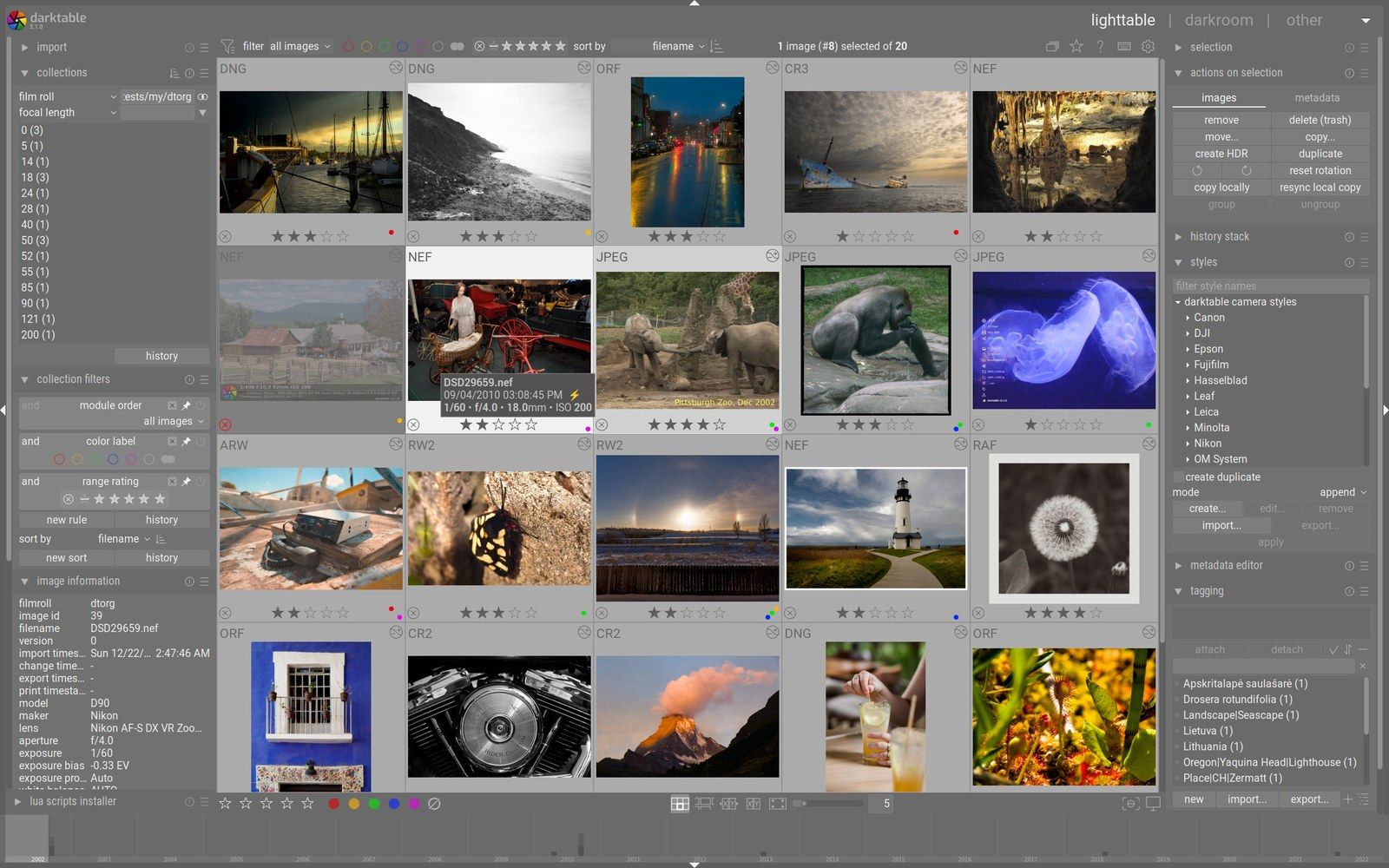
The processing philosophies diverge early and stay divergent. darktable organises its work as a scene-referred pipeline: images enter in a linear light space, edits are applied in physical-light terms — exposure in stops, colour by chromaticity, tone by luminance — and the result is rendered to display at the end. From version 3.0 onward the project pushed this model hard, moving away from legacy Lab-colour tools toward a suite of scene-referred modules of which the sigmoid tone mapper and the color calibration module (built around the CAT16 chromatic adaptation transform) are the clearest expression. Version 4.0, released in December 2022, consolidated those changes and dropped several legacy-mode defaults that had persisted for backward compatibility.

RawTherapee takes a different architectural stance. Its pipeline is non-destructive but more traditionally structured: demosaicing happens early, and the toolset — though wide — is presented in a broadly sequential order familiar to anyone who learned editing on Lightroom or Capture One. Its signal processing strengths are in demosaicing algorithms: it ships multiple methods including AMaZE, LMMSE, and IGV, with a dual-demosaic option that blends algorithms for high-ISO work. RawTherapee's handling of raw format compatibility is extensive, running to thousands of camera profiles, and the project updates this list quickly when new hardware ships.
What the Open-Source Model Buys and Costs
Both programs carry GNU General Public License terms — darktable under GPLv3, RawTherapee also GPLv3. That means the code is auditable, forkable, and will not disappear behind a server decision. It also means development velocity depends on volunteer time and the occasional commercial sponsor rather than a product roadmap with deadlines. darktable has benefited from structured support through its GitHub organisation, and a small number of sustained contributors — Aurélien Pierre on the scene-referred pipeline work being the most visible in recent years — but the user-facing stability gaps that once made both programs difficult to recommend to working photographers have largely closed.
Neither program matches Lightroom's catalog management in maturity. darktable's collection system is functional and improving; its lighttable view handles large libraries, and the sidecar-based non-destructive workflow is well designed. RawTherapee has no catalog layer at all — it works file-by-file or in batch, and practitioners who need robust library organisation typically pair it with a separate tool. That gap matters professionally: Capture One's catalog and tethering workflow remains a commercial benchmark neither open-source project has displaced.
Where both programs hold ground with professional credibility is in colour science and noise handling. darktable's color calibration module, using spectral data from ColorChecker charts, produces accurate, methodical colour profiles. RawTherapee's noise reduction — particularly its wavelets-based approach — was competitive well before neural-network denoisers from Topaz Labs or DxO entered the conversation, and it remains capable at moderate ISO values. Neither yet ships an AI-based denoise layer equivalent to DxO DeepPRIME or Topaz DeNoise, which represents the clearest technical distance between the open-source line and the current commercial tier.
The economics are simple: both programs are free to download, free to deploy on as many machines as a user owns, and free from the quiet price-rise pressure that governs subscription tools. For a photographer in a market where Lightroom's subscription cost accumulates to a meaningful annual figure, the capability-per-cost ratio of darktable or RawTherapee is not marginal — it is absolute. The 2013 backlash did not convert the industry, but it seeded a user base that sustained both projects through a decade of genuine development, and the software that emerged is not a compromise. It is a different set of trade-offs, clearly documented, with no renewal date.